How to Store Wine at Home Without a Cellar: Simple Rules That Work

| TL;DR: You can store wine at home without a cellar by choosing the coolest, darkest, most temperature-stable spot you have, laying cork-finished bottles on their sides, and avoiding kitchens, garages, and sunny shelves. U.S. wine consumption still reached 870 million gallons in 2024, so even everyday bottles are worth protecting (Source: Wine Institute, 2024). |
| KEY TAKEAWAYS • The best no-cellar storage spot is usually an interior closet, under-bed box, or a stable basement corner. • Temperature stability matters more than chasing a perfect number. • Kitchens, garages, laundry areas, and sunny windows are the fastest ways to ruin wine. • Cork-finished bottles should rest on their sides; screw-cap bottles are less picky. • A regular fridge is fine for a few days, not for months. • Most beginner bottles are drink-soon wines, not aging projects. |
How to store wine at home without a cellar comes down to four things: cool temperature, steady conditions, darkness, and low movement. You do not need a basement or a fancy wine fridge to protect a few good bottles. You do need a better plan than a sunny kitchen rack. The category is still worth protecting: U.S. wine consumption reached 870 million gallons in 2024 (Source: Wine Institute, 2024). How to store wine at home without a cellar gets much easier once you rank your rooms honestly.
Table of Contents
How to Store Wine at Home Without a Cellar: Start With the Four Rules
How to store wine at home without a cellar works best when you limit heat swings, light, vibration, and dry-air exposure. That matters even for casual drinkers. Global wine consumption was about 214 million hectoliters in 2024, which shows how many everyday bottles still deserve basic care (Source: OIV, 2025).
What is the best temperature to store wine at home?
Aim for a cool, steady area, ideally somewhere around 50-59 F for longer holding. Do not obsess over a perfect number if your home is not built for that. Stability matters more than chasing textbook cellar conditions. A closet that stays about the same all week is better than a room that swings from cool mornings to hot afternoons.
| Factor | Good-enough home rule | Why it matters |
| Temperature | Cool and steady | Big swings age wine faster |
| Light | Dark spot | UV can mute aroma and freshness |
| Movement | Low-traffic area | Vibration is not ideal for the bottle |
| Bottle position | Side for natural corks | Helps keep corks from drying |
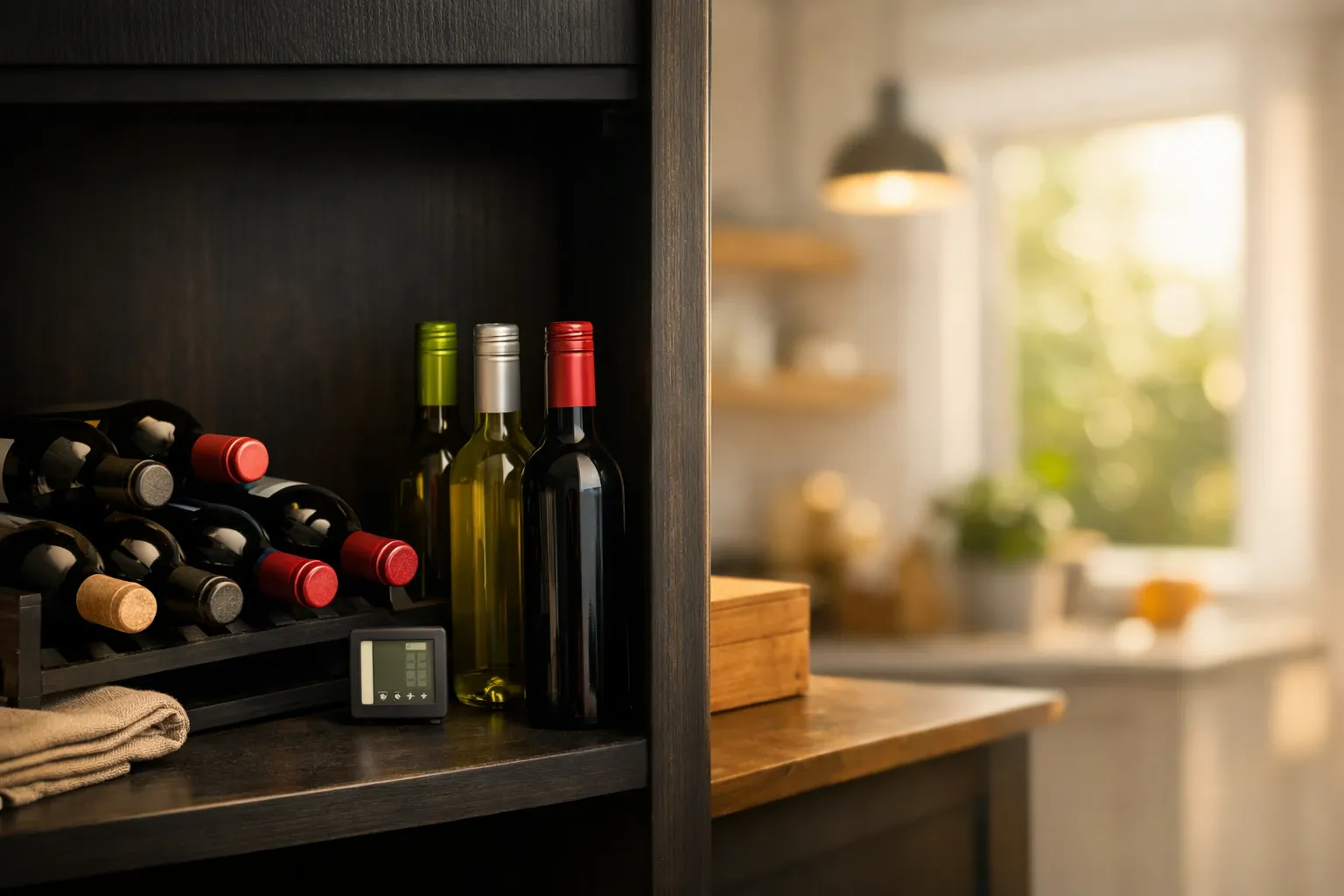
| Pro Tip: If you own only 6 to 12 bottles, buy a cheap digital thermometer before you buy a decorative wine rack. The thermometer tells you whether a spot is usable. The rack does not. |
If label terms like vintage, region, and closure still feel fuzzy, read How to Read a Wine Label for Beginners before you reorganize your shelf.
Where Should You Actually Put the Bottles?
How to store wine at home without a cellar is mostly a room-choice problem, not a gear problem. The best places to store wine at home without a cellar are usually an interior closet, a low shelf in a dark room, an under-bed box, or a stable basement corner. Those spots work because they stay away from windows, ovens, and day-to-day heat swings. That is the practical answer most page-one articles only hint at.
Where should I keep wine in my house?
Start with an interior closet. It is usually darker, more insulated, and less exposed to outside walls than a kitchen cabinet. A lower shelf is better than a top shelf because heat rises. If you live in a small apartment, an under-bed box can work well for a handful of drink-soon bottles. If you have a basement, use a stable corner and keep bottles off bare concrete.
| Home spot | Best for | Realistic hold time | Verdict |
| Interior closet | Most reds, whites, rose | 1-12 months | Best no-cost option |
| Under-bed box | Small stash in apartments | 1-6 months | Very good |
| Basement corner | Better bottles, cooler homes | 6-12 months+ | Good if stable |
| Hallway cabinet | Mixed everyday collection | 1-6 months | Good |
| Regular fridge | Pre-chilling and short holds | 3-5 days | Short-term only |
| Kitchen cabinet | Emergency only | Days, not months | Avoid |
| Garage | Almost never | Not recommended | Avoid |
For beginners, I would rather see six bottles stored well than twenty stored badly. That is also why The Complete Wine Guide for Beginners pairs well with this article: it helps you buy bottles that fit the way you actually drink.
Which Places Damage Wine Fastest?
The worst places for wine are kitchens, garages, laundry rooms, sunny shelves, and spots near ovens, dishwashers, dryers, radiators, or windows. Those areas combine heat, light, odors, and movement. If you make only one fix after reading this guide, move wine away from those zones.
Can red wine be stored at room temperature?
Yes, red wine can sit at room temperature for a short while, but modern room temperature is usually too warm for proper storage. Think hours or a few days for convenience, not months for quality. The moment a room feels warm to you every afternoon, assume the bottle is aging faster than you want.
| Danger zone | Main problem | Safe for long-term storage? |
| Kitchen | Heat spikes, appliance vibration, odors | No |
| Garage | Big temperature swings | No |
| Laundry area | Heat and vibration | No |
| Sunny shelf | UV and warmth | No |
| Near a radiator | Direct heat | No |
| Common Mistake: Storing wine on top of the fridge or next to the oven because it looks tidy. That spot combines warmth, vibration, and light exposure. |
Should Wine Be Stored Horizontally or Vertically?
Natural-cork bottles should usually rest on their sides if you are storing them beyond a quick hold. That keeps the cork in contact with the wine and lowers the chance that it dries out. Screw-cap bottles and many synthetic-cork bottles are less sensitive to position, so upright storage is usually fine when space is tight.
Which closures need side storage?
Put natural cork first in the sideways category. If your shelf space is limited, give the prime horizontal spots to cork-finished bottles like many Cabernet Sauvignon, Pinot Noir, Rioja, Bordeaux, and Barolo bottles. A screw-cap Sauvignon Blanc is much more flexible. That small distinction makes home storage easier and more realistic.
| Bottle type | Best position | Why |
| Natural cork | Horizontal | Helps keep the cork from drying |
| Screw cap | Upright or horizontal | Position is less critical |
| Synthetic cork | Upright or horizontal | Less affected by drying |
| Sparkling wine | Usually upright for short-term storage | Pressure changes the risk profile |
If wine terms still blur together, Wine Terminology Every Beginner Should Know will make terms like dry, body, acidity, and tannin easier to read in storage and serving advice.
Is a Regular Fridge Enough, or Do You Need a Wine Fridge?
How to store wine at home without a cellar does not mean parking every bottle in the kitchen fridge. A regular fridge is fine for short-term storage, especially for whites, rosé, and sparkling wine you plan to drink soon. It is not a good long-term home for unopened bottles because it is colder, drier, and more active than wine likes. For a few days? Fine. For months? No.
Can wine be stored in a regular fridge?
Yes, but only for a short hold. Use the regular fridge when you are pre-chilling bottles or keeping them safe for a few days. Once you start storing unopened wine there for weeks, the cold and dryness work against you, especially with natural corks. If your home runs hot for long stretches, a wine fridge starts making sense as a quality tool rather than a luxury.
| Storage setup | Best use | Hold time | Biggest downside |
| Regular fridge | Pre-chilling, short-term hold | 3-5 days | Too cold and dry for months |
| Interior closet | Everyday home storage | 1-12 months | Depends on home temperature |
| Wine fridge | Better bottles, warm homes, summer | Months to years | Costs money and takes space |
If you also want clear opened-bottle rules, read How Long Does Opened Wine Last in the Fridge? Because unopened storage and opened storage are not the same problem.
How Long Can Different Wines Stay at Home Without a Cellar?
Most beginner wines should be treated as drink-soon bottles unless you have a very steady home setup. That is the simplest rule in this whole article. Plenty of wines are made for pleasure in the near term, not for patient aging. Wine Market Council says 34 percent of American adults drink wine, and its 2025 research puts Millennials at 31 percent of wine drinkers, ahead of Boomers at 26 percent (Source: Wine Market Council, 2025).
How long can red wine be stored at room temperature?
A basic red can be fine at room temperature for days or a few weeks if your home stays cool and steady, but not for months in a warm room. Closet storage gives you far more breathing room than countertop storage. That is especially true for Pinot Noir and softer everyday reds.
Do I need a wine fridge to store wine properly?
No, not for a few ready-to-drink bottles. Yes, it can be worth buying if you plan to hold wine through a hot summer, protect pricier reds, or build a small collection. Buy with your storage conditions in mind. That fits moderation trends too: alcohol is linked to 5.4 percent of new cancer cases and 4.1 percent of cancer deaths in the United States (Source: NIAAA, 2025).
| Wine type | No-cellar hold time | Best home spot | Note |
| Sauvignon Blanc | 1-6 months | Closet or fridge short-term | Drink fresh |
| Pinot Grigio | 1-6 months | Closet or fridge short-term | Not an aging wine |
| Rose | 1-6 months | Cool closet | Freshness matters |
| Prosecco or sparkling | 1-6 months | Cool closet, then chill | Best young |
| Pinot Noir | 3-12 months | Closet or stable cool room | Protect from heat |
| Cabernet Sauvignon | 6-12 months+ | Best stable spot you have | Better bottles deserve care |
| Sweet or fortified wine | Varies | Cool, dark shelf | More forgiving |
If you are still learning what Pinot Noir is supposed to taste like before you decide whether to buy more of it, What Does Pinot Noir Taste Like for Beginners? is the right next read.
Frequently Asked Questions
How should wine be stored at home?
How to store wine at home without a cellar starts with the coolest, darkest, most stable spot you have. An interior closet or under-bed box usually works better than a kitchen cabinet. Cork-finished bottles should lie on their sides, while screw-cap bottles are more flexible.
Should wine be stored horizontally or vertically?
Store natural-cork bottles horizontally if you are keeping them for more than a short while. That helps keep the cork from drying out and lowers oxidation risk. Screw-cap and many synthetic-cork bottles can be stored upright or sideways because position matters less for those closures.
Can wine be stored in a regular fridge?
Yes, a regular fridge works for short-term storage, especially when you plan to drink the bottle within a few days. It is not a good long-term solution because the environment is too cold and dry for months of storage, especially for natural-cork bottles.
What is the best temperature to store wine at home?
The best home storage temperature is a cool, steady range, usually around 50-59 F. The exact number matters less than consistency. A closet that stays steady is better than a room that swings wildly between cool mornings and hot afternoons.
How long can red wine be stored at room temperature?
Red wine can sit at room temperature briefly, but modern room temperature is usually too warm for proper storage over time. If the room runs warm or changes a lot during the day, move the bottle to a closet, basement corner, or another darker, cooler spot.
Do I need a wine fridge to store wine properly?
How to store wine at home without a cellar does not require a wine fridge for a few drink-soon bottles. You may want one if your home stays warm, you buy wine ahead for months, or you want to protect better bottles through summer. It becomes a quality tool, not a beginner requirement.
Final Thoughts
How to store wine at home without a cellar is not a mystery. Pick a cool, dark, steady place. Keep cork-finished bottles on their sides. Use the regular fridge only for short-term holding. Treat most beginner bottles as drink-soon wines, not mini cellar projects. That is the simple rule set that protects quality without making wine feel complicated.
• Choose an interior closet before you choose a kitchen rack.
• Protect wine from heat swings first, then worry about perfection.
• Match the bottle position to the closure.
• Use a wine fridge only when your home or buying habits call for it.
| CTA: Store wine properly at home – learn easy storage tips! |
| AUTHOR BIO: Muhammad Ahsan is the wine blogger behind WizePulse, where he helps USA beginners understand wine without snobbery, overcomplication, or buying regret. |