
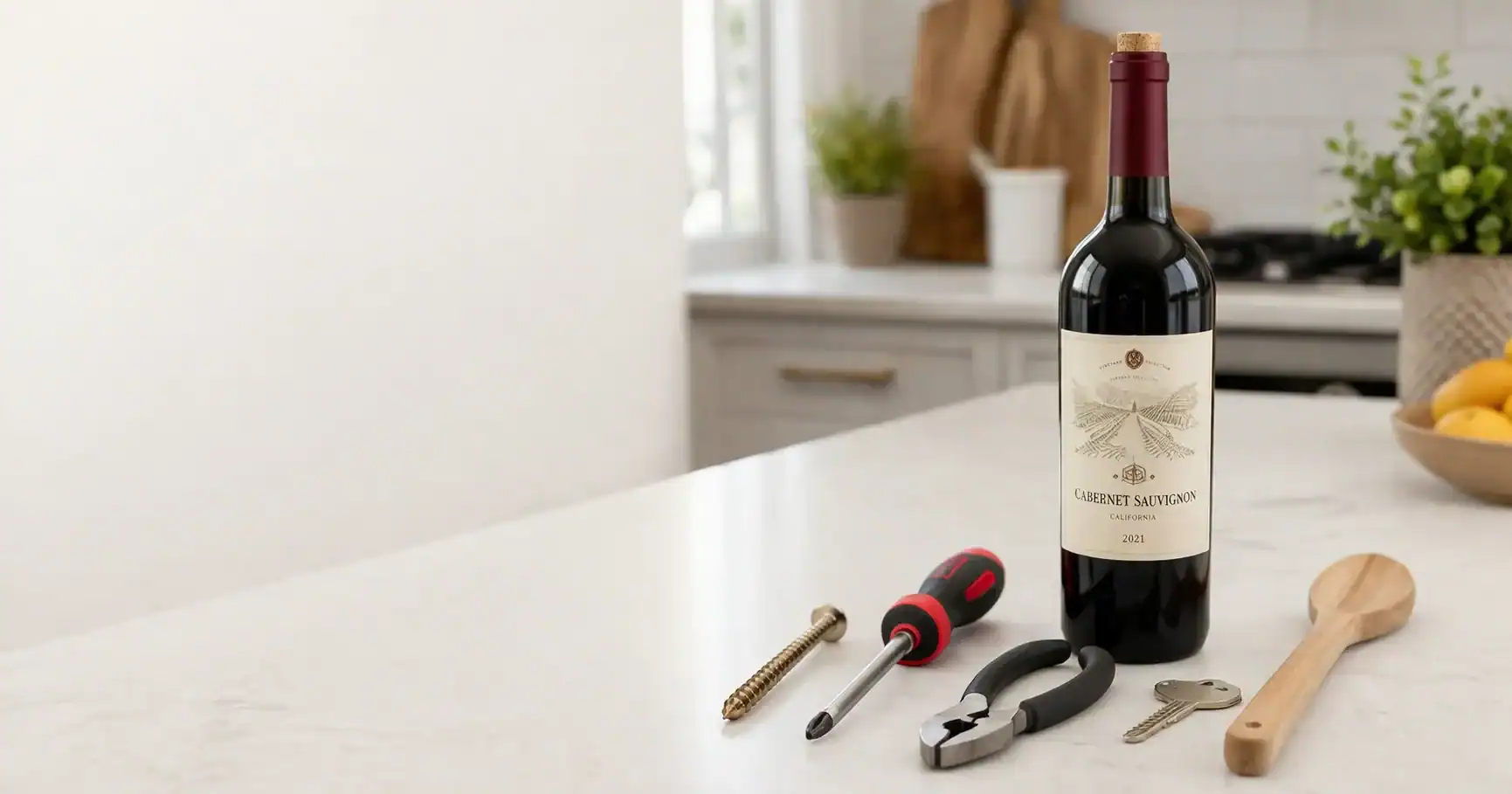
How to Open a Wine Bottle Without a Corkscrew: 5 Safe Methods

You’re ready to pour a glass, then realise the opener is nowhere in sight. The good news is that learning how to open a wine bottle without a corkscrew is usually less about force and more about choosing the safest method for the tools you already have. For most people, the best backup is a long screw and a hammer or pliers. If you have no tools at all, pushing the cork into the bottle is the simplest fallback. These methods are for standard still wine bottles, not sparkling wine.
This guide keeps things practical and beginner-friendly. You’ll get the safest methods first, the riskiest hacks clearly labelled as last resort only, and a simple plan for dealing with a broken or crumbled cork.
| Key Takeaways • Best overall fix: use a screw plus pliers or a hammer claw. • Easiest no-tool backup: push the cork into the bottle. • Key and bike-pump methods can work, but they need more control. • A few cork bits in the wine usually aren’t a big deal; strain if needed. |
Table of Contents
What’s the safest way to open a wine bottle without a corkscrew?
The safest way to open a wine bottle without a corkscrew is usually the screw-and-hammer method. It works like a DIY opener, gives you controlled upward force, and is more reliable than hacks that depend on impact, heat, or sharp blades. If you have no tools, pushing the cork into the bottle is the easier backup.
| Method | Tools | Difficulty | Risk | Mess | Best For |
| Screw + pliers/hammer | Basic tools | Medium | Low–Medium | Low | Best overall control |
| Push cork in | Blunt tool | Easy | Low | Medium | No-tool emergency |
| Key method | House key | Medium | Medium | Medium | Common household fix |
| Bike pump | Pump + needle | Medium | Medium–High | Low | Cleaner removal if you have the tool |
If you’re hosting friends and want the least stressful option, use the method that gives you control over the cork instead of trying to shock it out. That’s why the screw method beats most viral hacks. If your only goal is to get the bottle open right now, pushing the cork in is faster, even if it’s less tidy.
If you’re still building wine confidence, The Complete Beginner’s Guide to Wine is the best next stop after this article.
Before you try anything, do these 4 safety checks (How to Open a Wine Bottle Without a Corkscrew)
Before you try any no-corkscrew method, take 30 seconds to make the setup safer. Dry the bottle, clear the area, avoid cracked glass, and protect your hands. Most DIY bottle-opening mistakes happen because the bottle slips, the tool shifts, or the force gets uncontrolled.
• Dry the bottle neck and your hands so nothing slips at the worst moment.
• Check the bottle for cracks or chips. If the glass is damaged, don’t force it.
• Use a folded towel and a stable surface to improve grip and contain any mess.
• Skip heat and sharp-object tricks unless you genuinely have no safer option.
A practical example: if you’re opening a bottle on a crowded kitchen counter while guests are nearby, don’t reach for a knife trick just because it looks quick in a video. Move the bottle to a stable surface, wrap the lower half with a towel, and give yourself room to work. That tiny pause makes every method easier.
Method 1: Use a screw, screwdriver, and hammer
If you have a long screw, a screwdriver, and either pliers or a hammer claw, this is the best method to try first. It gives you the most control, removes the cork instead of shoving it into the bottle, and usually creates less mess than other backup options.
What you need
• One long screw, ideally about 2 inches
• A screwdriver
• Pliers or a hammer with a claw
• A towel for grip
Step-by-step
1. Remove any foil on top of the bottle.
2. Twist the screw into the center of the cork.
3. Stop when about half an inch of the screw is still exposed.
4. Hold the bottle steady with the towel.
5. Use pliers or the hammer claw to pull upward slowly, like you’re removing a nail.
6. Wiggle gently if the cork feels tight, but don’t yank.
Why it works: the screw gives you a firm anchor inside the cork. Instead of crushing the cork downward, you’re pulling it upward in a controlled way. That makes this feel closest to using a real opener.
The main edge case is an old, dry, or already damaged cork. If the screw starts tearing through the cork instead of lifting it, stop and switch to the push-in method rather than forcing it. A crumbled cork is annoying, but broken glass is worse.
If you’re choosing bottles for a casual dinner after you get this one open, Best Wines for Beginners is a useful follow-up.
Method 2: Push the cork into the bottle
If you don’t have tools, pushing the cork into the bottle is the easiest emergency method. It isn’t elegant, and it can leave bits of cork floating in the wine, but it avoids sharp tools and usually works with nothing more than a sturdy spoon handle or similar blunt object.
A wooden spoon handle works well. So can a thick marker or another solid blunt item that won’t snap under pressure. Avoid anything flimsy or sharp.
Hold the bottle firmly on a counter, keep it upright, and press straight down into the middle of the cork. The key is steady force. Don’t jab. Don’t twist wildly. Just keep pressing until the cork drops into the bottle. Be ready for a small splash.
This is the best choice when you only care about getting the bottle open and drinking it right away. It’s less ideal if you want a neat pour, plan to save the rest, or know the cork is already crumbly. Synthetic corks can also feel stiffer and more slippery than natural corks, so expect more resistance.
If cork bits fall in, pour slowly. For more debris, use a fine strainer. A few floating pieces are mostly a texture issue, not a sign that the wine is ruined.
Method 3: Use a key to twist the cork out
A house key can work when you want to avoid pushing the cork into the wine, but it takes patience. The trick is to insert the key at an angle, then twist and pull gradually. Done carefully, it can loosen the cork enough to ease it out.
1. Insert the key into the cork at about a 45-degree angle.
2. Push it in far enough to get a grip.
3. Twist the key while gently pulling upward.
4. Rotate the bottle or your wrist as needed.
5. Keep the motion slow, so the cork doesn’t split.
This method is useful when you have no tools and don’t want a cork floating in the bottle. But it’s easier to mess up than the push-in method. If you rush it, the key can slip, or the cork can crumble. Think of it as a finesse move, not a force move.
A basic house-party situation is where this method shines: no opener, no toolbox, but everyone has keys. Just don’t expect it to feel smooth on the first try.
Method 4: Use a bike pump or pressure-based method
A bike pump with a needle attachment can open a wine bottle without a corkscrew, but it belongs behind the first three methods for most beginners. It can work well and keep the cork more intact, yet pressure methods need patience because too much force too quickly can be unsafe.
Insert the needle through the cork and pump slowly so pressure builds under the cork. If the cork shifts oddly, the bottle feels unstable, or you feel tempted to pump harder just to speed things up, stop and switch methods.
Use this only if you already have the right pump and needle, the bottle is in good condition, and you can keep the bottle pointed away from people. This is one of those methods where ‘almost there’ is the moment to stay calm, not force it.
What to avoid, what to do if the cork breaks, and which method to choose
Not every wine-opening hack is worth trying. Knife tricks, heat methods, and hard-impact methods may look dramatic, but they’re poor default choices for beginners. If the cork breaks, the wine is usually still salvageable. The smart move is to recover calmly, not escalate to a riskier hack.
Methods to avoid or save for last resort
• Knife method: easy to slip and easy to split the cork.
• Heat method: unpredictable and too risky around glass.
• Shoe or wall method: popular online, but inconsistent and messy.
• Breaking the neck or sabering: not for still wine and never a casual kitchen fix.
What if the cork breaks or falls into the wine?
First, don’t panic. If just a few pieces of cork fall in, fish them out or pour slowly. If there’s more debris, strain the wine into another container. Cork pieces are annoying, but they usually don’t mean the wine itself is bad.
Which method should you choose?
• Have a screw and hammer or pliers? Start there.
• No tools at all? Push the cork in.
• Only have a key? Try the key method slowly.
• Have a bike pump and steady hands? The pressure method can work.
• Thinking about a knife or heat hack? Don’t, unless you truly have no safer option.
If pizza is on the menu once the bottle’s open, What Wine Pairs Best with Pizza is a simple next read.
FAQ
Can you open a wine bottle with just a spoon?
Yes—if you use the spoon handle to push the cork down into the bottle. It’s one of the easiest no-tool methods, though it can create splashback and cork crumbs.
What if cork pieces end up in the wine?
A few cork pieces usually aren’t a big deal. Pour carefully, fish them out, or strain the wine into another container if needed.
Do these methods work on synthetic corks?
Sometimes, but synthetic corks can behave differently. They’re often more slippery and less likely to crumble, which can change which method feels easiest.
Can I use these methods on sparkling wine?
No. Sparkling wine should be opened with a different process because the bottle is pressurised. Keep this guide for standard still wine bottles only.
Final takeaway
If you need the shortest answer, use a screw and hammer or pliers first. It’s the most controlled fix and the closest thing to a real opener. If you’ve got nothing but kitchen tools, push the cork in and pour carefully. And if a hack looks dramatic enough for social media, there’s a good chance it belongs in the “don’t try this first” category.
No corkscrew? No problem—learn easy opening hacks!