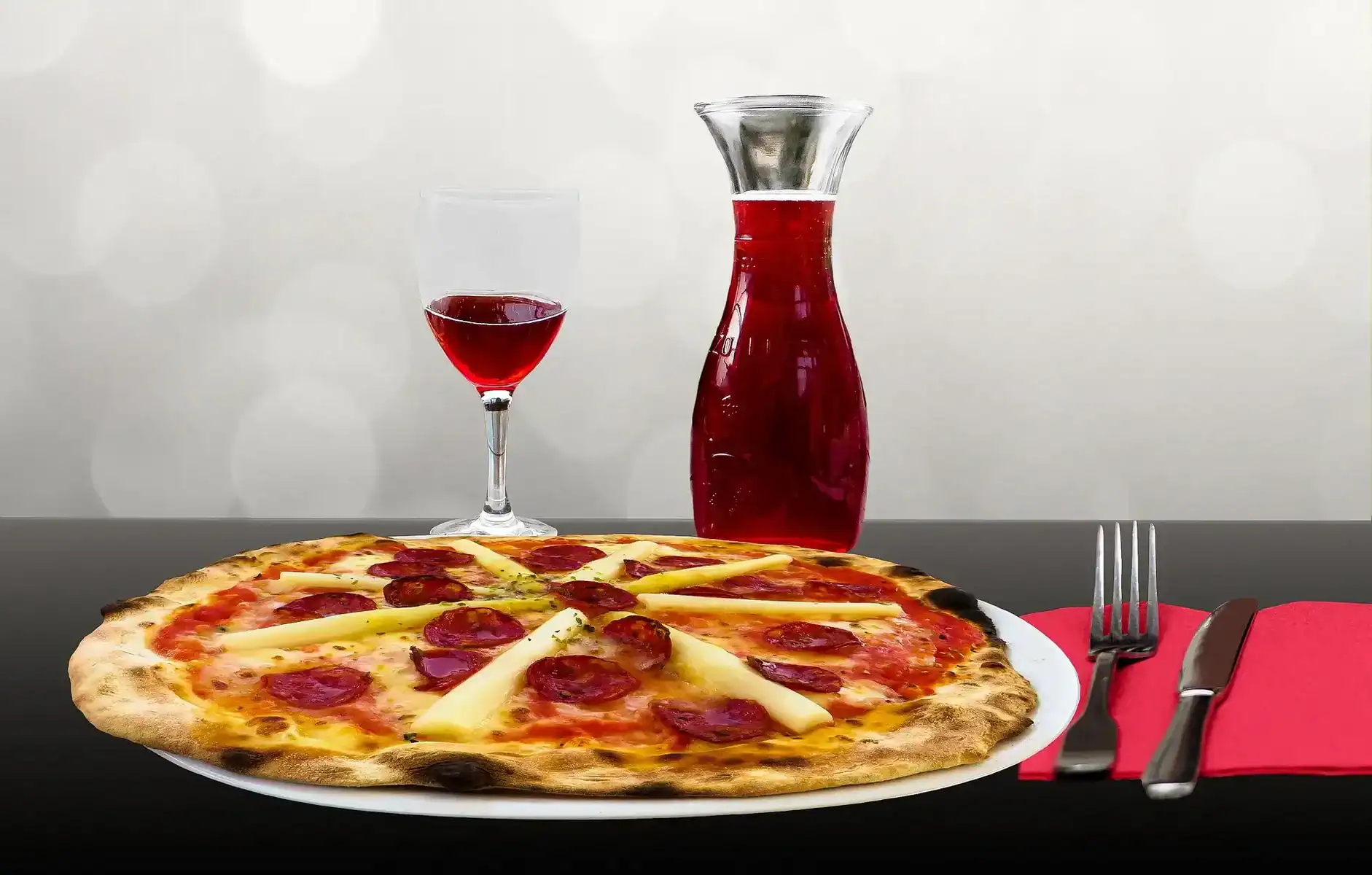
What Wine Pairs Best with Pizza? (The Real Answer)

The delivery box is open. There’s a glass of wine somewhere in the kitchen. Does it matter which wine with pizza you reach for?
For most people, the honest answer has always been “grab whatever’s open.” But a small, specific choice makes every slice taste genuinely better. The reason why takes about 30 seconds to understand.
Tomato sauce is highly acidic. Its pH sits around 4.0 to 4.4, roughly the same range as black coffee. When you pour a wine that can’t match that acidity level, it tastes flat and thin alongside the tomato. Wine that meets or exceeds the sauce’s tartness tastes brighter, more alive, and genuinely complementary. That single insight explains every good pairing on this page.
This guide applies that rule to eight pizza styles, from classic Margherita to BBQ chicken, with a specific bottle recommendation for each. All under $25. All available at Total Wine, Costco, or large grocery stores across the USA.
The Short Answer
- The #1 rule: high-acid wine with tomato sauce. Italian reds (Chianti, Barbera, Sangiovese) evolved alongside high-acid food.
- For any pizza, Prosecco works universally — the bubbles reset your palate and the acidity cuts through the cheese.
- Ruffino Chianti ($10–$13 at Total Wine) is the best-value pizza wine in America.
- La Marca Prosecco ($16–$19 at Costco) is the universal pick for any table.
- White pizza breaks the rule: without tomato sauce, reach for Chardonnay or Pinot Grigio instead.
- Americans eat approximately 3 billion pizzas per year (PMQ Pizza Magazine).
Table of Contents
What’s the Best Wine Pairing for Every Pizza Style?
Americans eat approximately 3 billion pizzas per year, about 23 pounds per person annually, according to PMQ Pizza Magazine. Pepperoni alone appears on roughly 36% of all pizzas ordered. Getting the wine with pizza pairing right matters. Here’s the complete wine with pizza pairing guide you can scan in under a minute:
| Pizza Style | Best Wine | Why It Works | Budget Pick |
| Margherita | Dry rosé or light Chianti | Bright acidity matches tomato; rosé won’t overpower basil | Meiomi Rosé ($16–$20) |
| Pepperoni | Sangiovese / Chianti Classico | Earthy acidity + spiced meat = textbook contrast pairing | Ruffino Chianti ($10–$13) |
| Cheese pizza | Pinot Noir or Barbera | Light red suits rich cheese without tannic grip | Meiomi Pinot Noir ($18–$22) |
| White pizza | Chardonnay or Pinot Grigio | Cream/garlic richness matches an oaked or medium white | KJ Vintner’s Reserve ($14–$18) |
| Veggie pizza | Sauvignon Blanc or light red | High acidity + fresh vegetables = flavor-forward pairing | Kim Crawford ($15–$18) |
| Meat lovers | Cabernet Sauvignon or Malbec | Bold tannins cut fat; dark fruit amplifies spiced meat | Josh Cabernet ($13–$17) |
| BBQ chicken | Malbec or off-dry Riesling | Fruit-forward Malbec mirrors the smoky-sweet sauce | Don Miguel Gascón ($12–$15) |
| Hawaiian | Off-dry Riesling or Moscato | Sweetness balances pineapple; acidity cuts the salty ham | Ste. Michelle Riesling ($8–$12) |
New to wine? Our complete beginner’s guide to wine covers the foundational concepts — including how to think about acidity — before you dive into pairing.
Citation: Pepperoni is the most popular pizza topping in the USA, appearing on approximately 36% of all orders (PMQ Pizza Magazine). Sangiovese’s bright cherry acidity provides a classic contrast pairing with fatty, well-seasoned toppings. Source: PMQ Pizza Magazine; Wine Folly
Why Does Acidity Matter So Much for Pizza and Wine Pairing?
Tomato sauce has a natural pH of approximately 4.0 to 4.4, placing it in the same acidity range as black coffee, according to Wine Folly and standard food science references. Pour a wine without sufficient acidity alongside high-acid tomato and the wine will taste flat, its fruit character dulled. Pour a wine that matches or slightly exceeds the tomato’s tartness and both the food and the wine taste sharper, more alive, more complete.
This is the complementary acidity principle, and it’s the reason Italian wines dominate pizza pairings almost universally.
Italy’s wine regions grew up alongside high-acid food: tomatoes, preserved meats, aged cheese. Sangiovese, Barbera, and Montepulciano all have naturally high tartaric acid content built into their grape character, shaped by centuries of pairing with exactly these flavors. They’re not good with pizza by coincidence. They’re good with pizza by design.
White pizza removes tomato sauce entirely — dominant flavors shift to cream, garlic, and fresh cheese. You want body and texture, not acid.
BBQ chicken and sweet sauces also break the rule — fruit-forward wines (Malbec, off-dry Riesling) work better here.
| High-Acid Wines: Best for Tomato Pizza | Lower-Acid Wines: Better for White Pizza & BBQ |
| Chianti / Sangiovese | Oaked Chardonnay |
| Barbera d’Asti | Malbec |
| Pinot Noir | Grenache |
| Sauvignon Blanc | Merlot |
| Prosecco / Cava | Viognier |
These high-acid wines are the backbone of Italian wine culture — shaped by centuries of pairing with tomato-based cooking.
Citation: High-acid foods require wines with equal or greater acidity — otherwise the wine tastes flat and unbalanced. Tomato sauce at pH 4.0–4.4 makes Italian reds the most reliable pizza partners. Source: Wine Spectator; Wine Folly
What’s the Best Wine for Red Sauce Pizza? The Italian Classics
For any pizza built on tomato sauce, Italian reds are the most reliable choice. Sangiovese is the most widely planted red grape in Italy, accounting for roughly 10% of total Italian vineyard surface, according to Wine Folly. That dominance isn’t accidental. Its high natural acidity was shaped by centuries of pairing with exactly the tomato-based food culture that invented pizza.
Chianti and Chianti Classico: The Default Pizza Wine
Chianti is the obvious answer, and it’s obvious because it’s right. By Italian law, Chianti DOCG must contain at least 75% Sangiovese, which means that cherry-bright acidity and earthy, slightly spiced character appear in every bottle regardless of producer.
I’ve had Ruffino Chianti with a pepperoni delivery pizza more times than I can count. The tartness in the tomato sauce almost amplifies when Chianti meets it. This is the definitive wine with pizza pairing at the price point — it makes you feel like you made a smart decision for $11.
Ruffino Chianti: $10–$13 at Total Wine | Antinori Santa Cristina: $14–$17 at Total Wine
Food pairing: Pepperoni, sausage, four-cheese, Margherita
Barbera d’Asti: The Underrated Alternative
Barbera d’Asti is Chianti’s lower-tannin, higher-acid cousin from Piedmont. It’s more fruit-forward (dark cherry, cranberry), deeply acidic, and practically designed for tomato-based food — far less known in the USA, which means better value per bottle.
Michele Chiarlo “Le Orme” Barbera d’Asti: $14–$17 at Total Wine
Montepulciano d’Abruzzo: The $10 Secret
Note: Montepulciano d’Abruzzo is the wine from the Abruzzo region — not the same as Vino Nobile di Montepulciano from Tuscany. The names confuse even experienced wine buyers, but the ‘d’Abruzzo’ tells you exactly where it’s from. The wine itself is deep, plummy, modestly tannic, and well-acidic. It consistently outperforms its price.
Masciarelli Montepulciano d’Abruzzo: $10–$14 at Total Wine
Citation: Chianti DOCG requires at least 75% Sangiovese by Italian law. Barbera d’Asti and Montepulciano d’Abruzzo offer compelling alternatives — both high-acid, both food-friendly, both available for $10–$17. Source: Italian DOC/DOCG wine law; Decanter
See all these wines in our guide to the best cheap wines under $20, where several of them make the full list.
Does Sparkling Wine Work with Pizza? (It’s Actually the Best Choice)
Prosecco is the world’s best-selling sparkling wine by volume, with Italy exporting over 600 million bottles annually in 2025 (Prosecco DOC Consortium). Prosecco’s light acidity, fine carbonation, and slight sweetness make it one of the most food-flexible wines produced anywhere.
Here’s the mechanism most wine guides skip: carbonation physically lifts fat and dairy molecules off your palate between bites. The bubbles displace the residual richness from the mozzarella, giving you a genuinely fresh palate for the next slice. This is the same reason Champagne works with fried food. The cleaning effect is mechanical, not just complementary.
La Marca Prosecco ($16–$19 at Costco and Total Wine)
The USA’s best-selling Prosecco by volume. Light, fine bubbles, notes of honey and cream. Keep one in the fridge permanently during pizza season.
Lambrusco: The Italian Sparkling Red
Made in Emilia-Romagna — the same region that gave the world Parmigiano and Prosciutto di Parma. Lambrusco is slightly fizzy, slightly sweet, and only about 10.5% alcohol. A genuinely Italian pizza wine most Americans have never tried. Riunite Lambrusco: $7–$10 at Total Wine.
Cava: The Budget Champagne-Method Option
Spanish Cava is made using the same method as Champagne, giving it finer, more persistent bubbles than tank-method Prosecco. Drier and crisper. Works especially well with white pizza and vegetarian styles. Freixenet Cordon Negro Cava: $10–$14 at Total Wine.
Citation: Carbonation serves a functional pairing role — the bubbles physically displace fat from the palate between bites, producing a fresher eating experience. This is why Prosecco, Lambrusco, Cava, and Champagne all work universally with pizza. Source: Wine Folly
What Wine Works Best with White Pizza?
White pizza removes tomato sauce entirely and changes the whole pairing calculation. Without tomato, the dominant flavors shift to cream, garlic, olive oil, and fresh cheese — all richness-forward. These flavors don’t need a high-acid wine. They need a wine in the same body register: creamy, textured, and soft-edged. The acidity rule has flipped.
Oaked Chardonnay: The Natural Match
Cream and butter share the flavor register with oaked Chardonnay. The wine’s vanilla and toast notes, lightly creamy texture, and gentle acidity work in the same key as the cream sauce. Kendall-Jackson Vintner’s Reserve Chardonnay: $14–$18 at Costco.
Pinot Grigio: The Lighter Alternative
For a less-rich white pizza — thin crust with fresh mozzarella, arugula, lemon, olive oil — Pinot Grigio’s lighter frame and crisp finish works better than the Chardonnay’s weight. Santa Margherita Pinot Grigio: $20–$25 at Total Wine.
Pinot Noir: The Mushroom Exception
If the white pizza has mushrooms, truffle oil, or earthy toppings, Pinot Noir’s forest-floor character pairs beautifully even without tomato sauce. Meiomi Pinot Noir: $18–$22 at Costco.
Citation: White pizza shifts the pairing logic — richness-matching replaces acidity-matching. Oaked Chardonnay ($14–$18) mirrors white pizza’s buttery register; Pinot Grigio serves lighter-crust versions; Pinot Noir works specifically when earthy toppings are present. Source: Author expertise
What Wine Goes with BBQ Chicken, Hawaiian, and Delivery Pizza?
BBQ chicken pizza, Hawaiian, and the classic loaded-delivery-special are distinctly American inventions. They’ve moved away from classic tomato toward sweet, smoky, and complex sauce profiles — and each one needs a different approach.
BBQ Chicken Pizza: Reach for Malbec
Malbec’s fruit-forward plum and blackberry notes mirror the smoky-sweet BBQ sauce without fighting it. The wine’s body is substantial enough for the chicken; its tannins are soft enough not to clash with the sweetness. Don Miguel Gascón Malbec: $12–$15 at Total Wine. Catena Malbec ($18–$22) is worth it for a nicer occasion.
Hawaiian Pizza: Off-Dry Riesling (Seriously)
The counterintuitive answer that actually works. Sweet pineapple needs a wine with its own sweetness — or both the wine and the fruit fight each other. Chateau Ste. Michelle Columbia Valley Riesling ($8–$12 at Costco) has the off-dry sweetness to match the pineapple while its high acidity cuts through the salty ham. Yes, Hawaiian pizza is divisive. The Riesling pairing is not.
Friday Delivery (Unknown Toppings): Prosecco Wins
When you don’t know exactly what’s coming in the box and you want one bottle for the whole table, Prosecco is the answer. La Marca ($16–$19 at Costco) works with every topping combination on the menu. All these bottles are available for under $20 at Total Wine and Costco.
Citation: American pizza styles like BBQ chicken and Hawaiian have departed from the Italian tomato-Sangiovese tradition. Off-dry Riesling handles Hawaiian pizza’s pineapple-and-ham combination more elegantly than any Italian red. Malbec mirrors BBQ sauce’s dark fruit and smoke character directly. Source: Author expertise
How Do You Build the Perfect Pizza and Wine Night?
If you’re ordering for a group with mixed topping preferences and you want one or two bottles that cover the whole table without thinking too hard, the two-bottle strategy beats trying to match each individual pizza.
Bottle 1: Ruffino Chianti ($10–$13) — handles all the red-sauce styles.
Bottle 2: La Marca Prosecco ($16–$19) — handles everything else: white pizza, veggie, Hawaiian, and anyone who wants bubbles.
Combined cost: $27–$32. Both are at Costco or Total Wine. Put them on the table and let people self-select.
Temperature tip: Chianti is better slightly chilled for pizza. Fifteen minutes in the fridge before you pour brings out the fruit character and softens any tannin grip. Prosecco straight from the fridge, always.
If you end up with an open bottle at the end of the night, don’t leave it on the counter. A recapped bottle of Chianti stays drinkable for three to five days in the fridge, and we tested exactly how long opened wine stays good — the results might change how you store your leftovers.
Citation: The two-bottle strategy (Ruffino Chianti $10–$13 + La Marca Prosecco $16–$19) covers the full table at a combined cost of $27–$32. The Chianti handles all red-sauce styles; the Prosecco handles everything else and works universally. Source: Author expertise
Frequently Asked Questions About Wine with Pizza
Is Red or White Wine Better with Pizza?
Red wine works best with tomato-based pizza because the high acidity in Italian reds mirrors the tomato sauce’s tartness. White wine is the right call for white pizza — cream and garlic flavors pair with Chardonnay or Pinot Grigio rather than tannic reds. For any pizza at all, Prosecco bridges both worlds. The sauce type, not personal preference, makes the call.
What Wine Goes with Pepperoni Pizza?
Chianti Classico is the definitive answer. The wine’s cherry acidity mirrors the tomato sauce while its earthy, slightly spiced character complements the pepperoni’s fat and seasoning. Ruffino Chianti ($10–$13 at Total Wine) is the best-value answer at US retail. Cabernet Franc is a less obvious but excellent alternative; its peppery finish amplifies the pepperoni spice beautifully.
Does Prosecco Go Well with Pizza?
Absolutely, and it may be the most underrated pizza wine in America. The carbonation physically resets your palate between bites, the light sweetness tempers spicy toppings, and the acidity cuts through cheese richness more cleanly than most still wines. La Marca Prosecco ($16–$19 at Costco) is the practical USA recommendation: one bottle that works with every pizza style on the table.
What Wine Goes with Margherita Pizza?
Dry rosé is the purist’s answer: its strawberry brightness and refreshing acidity match Margherita’s fresh tomato and basil without competing with the delicate mozzarella. Meiomi Rosé ($16–$20 at Total Wine) is the USA-available pick. A light Chianti also works beautifully, particularly if the Margherita has good crust char and a tangy tomato base.
What’s the Best Cheap Wine with Pizza?
Ruffino Chianti ($10–$13 at Total Wine or Costco) is the best-value pizza wine in America: high-acid Sangiovese base, food-friendly structure, widely available. For sparkling under $10, Riunite Lambrusco ($7–$10 at Total Wine) is the Italian choice. Chateau Ste. Michelle Riesling ($8–$12 at Costco) is the best budget pick for Hawaiian and BBQ-style pizzas.
The One Rule That Makes Every Wine with Pizza Pairing Work
The acidity principle covers nearly every wine with pizza decision in under five seconds. Tomato sauce: reach for a high-acid wine, Italian red or Prosecco. White pizza: flip to a rich white, Chardonnay or Pinot Grigio. Sweet-sauce American styles: go fruit-forward, Malbec or off-dry Riesling.
My standing pizza order is a Ruffino Chianti — $11 at Total Wine — opened twenty minutes before the delivery arrives. Every slice is better for it. If I’m feeding a group with mixed preferences, I add a bottle of La Marca Prosecco and let people self-select. Total spend: under $30. Nobody complains.
You don’t need a different bottle for every pizza style. You need to understand the rule, pick one or two bottles that fit it, and open them without overthinking.
Every wine in this guide is available for under $20. See our full budget wine guide for the complete list of bottles worth keeping on hand for any occasion, pizza night included.
SourcesWine Folly | Wine Spectator | Decanter | PMQ Pizza Magazine | Prosecco DOC Consortium | Italian DOC/DOCG Wine Law