
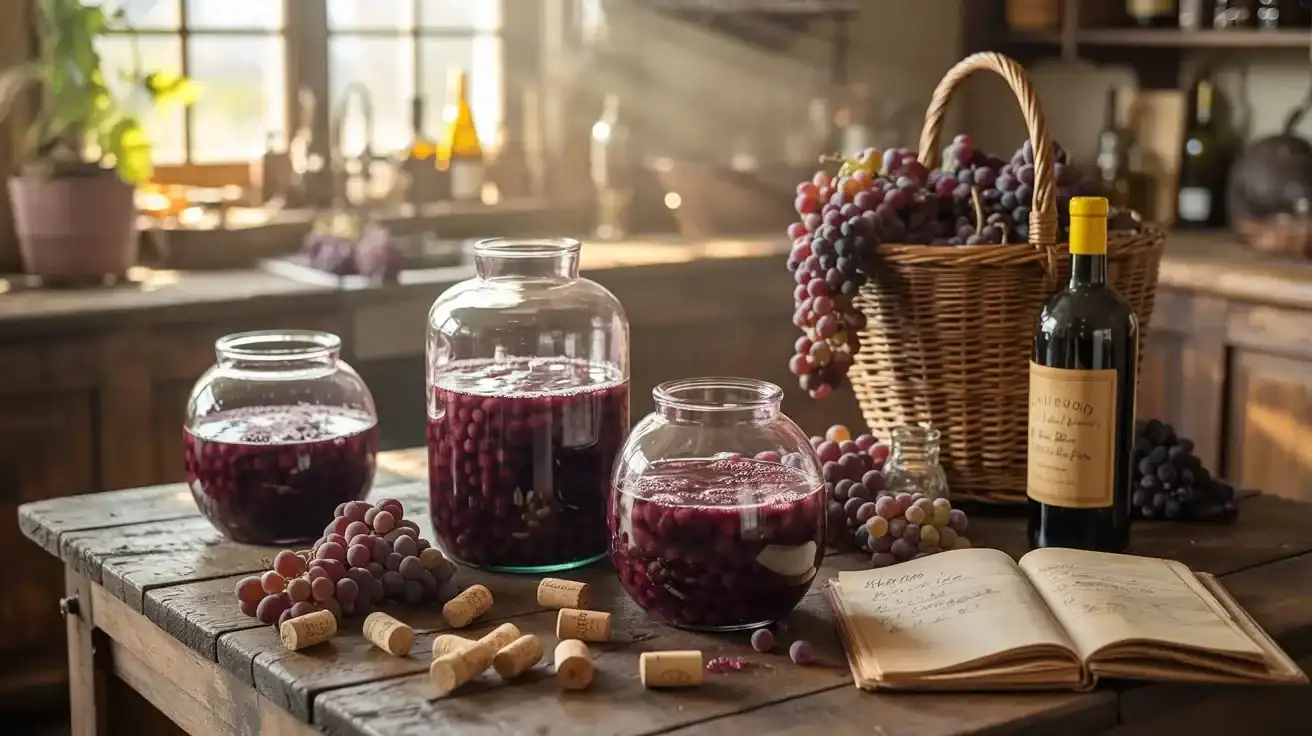
How to Make Wine at Home: A Complete Beginner’s Guide (7 Steps)

More than 1.2 million American households make their own wine or beer at home every year. Most of them started with zero winemaking experience, a basic kit from Total Wine, and a genuine curiosity about what happens when you add yeast to fruit juice.
If you’ve ever wondered how to make wine at home for beginners without wading through jargon-heavy guides written for professional winemakers, you’re in the right place. The process is genuinely simple. It’s mostly waiting, a little stirring, and a few key decisions made in the first 48 hours. I’ve walked through this myself more times than I can count, and the first successful batch, a strawberry wine I made in a one-gallon jug on my kitchen counter, changed the way I thought about wine entirely.
This guide walks you through everything, from legal basics to bottling day. Seven steps. No cellar required.
| KEY TAKEAWAYS |
| Home winemaking is federally legal in the USA, up to 200 gallons per household per year (TTB.gov) |
| A complete starter kit costs $40-$80 at Total Wine, Amazon, or MoreWinemaking.com |
| Most beginner batches are ready to drink in 6-10 weeks |
| You don’t need grapes: strawberries, blackberries, and apple juice all ferment beautifully |
| Sanitation is the single most important skill you’ll learn |
Table of Contents
Is It Actually Legal to Make Wine at Home in the USA? (Complete guide: How to Make Wine at Home)
Yes, and the federal government says so explicitly. Under 26 U.S.C. Section 5053(e), the Alcohol and Tobacco Tax and Trade Bureau (TTB) permits any adult US household to produce up to 200 gallons of wine per year (100 gallons if you live alone). That’s a lot of wine.
The key phrase is “personal or family use.” You can make it, drink it, share it with guests, and bring it to a dinner party. What you can’t do is sell it. Not a bottle, not a sip. The moment money changes hands, you’re in licensed winery territory.
Most states align directly with this federal standard. A handful of states have added their own layers. Mississippi has historically been the most restrictive, so it’s worth a quick search for your specific state before you start. But for the vast majority of Americans, the answer is simply yes.
Millions of people do this legally every weekend. There’s nothing underground or complicated about it.
| CITATION Under US federal law, any adult household can legally produce wine at home for personal and family use, with the TTB permitting up to 200 gallons per household annually. This allowance covers sharing with guests but does not extend to commercial sale. Most states mirror this federal standard. (Source: TTB.gov, 26 U.S.C. Section 5053(e)) |
What Equipment Do You Need to Make Wine at Home?
You can get everything you need for a first batch for $40-$80, and most of it ships from Amazon or Total Wine. That’s the number that surprises people most when they start researching home winemaking. They expect it to be expensive. It’s not.
The essential gear is small, practical, and available in a single order.
The Essential Equipment List
Here’s what you actually need for your first batch:
| Equipment Item | Why You Need It | Approx. Cost (USD) |
| 1-gallon glass jug (carboy) | Primary fermentation vessel | $8-$15 |
| Airlock + stopper | Vents CO2, blocks oxygen | $2-$4 |
| Hydrometer | Tracks sugar/alcohol levels | $6-$10 |
| Auto-siphon + tubing | Transfers wine off sediment | $10-$18 |
| Star San sanitizer | Prevents bacterial contamination | $8-$12 |
| Wine yeast (Lalvin 71B) | Ferments sugar into alcohol | $1-$2/packet |
| Campden tablets | Eliminates wild yeast before pitching | $4-$6 |
| Cheesecloth / straining bag | Strains fruit solids from juice | $3-$5 |
| Wine bottles + corks | For the finished product | $8-$15 for 6 |
[ CHART 1: Insert Bar Chart – Home Winemaking Kit Cost by Level (USD): Basic ~$65 / Intermediate ~$160 / Advanced ~$350. Source: Amazon/Total Wine/MoreWinemaking.com 2025 ]
Nice-to-Have Gear for Your Second Batch
- pH strips ($5-$8): cheap and useful for checking acid balance
- Wine thief ($8-$12): samples wine without exposing the full batch to oxygen
- Peristaltic pump ($40-$80): worth it once you’re making 5-gallon batches
You can find all of this at MoreWinemaking.com, on Amazon, or at your local Total Wine.
| CITATION A basic home winemaking setup costs between $40 and $80 in the USA, covering all essentials including a fermentation vessel, airlock, hydrometer, auto-siphon, and sanitizer. Intermediate setups run $120-$180. All core equipment is readily available through Amazon, Total Wine, and MoreWinemaking.com. (Sources: Amazon.com; MoreWinemaking.com, 2025) |
What Ingredients Do You Actually Need?
The ingredient list is shorter than you’d think: fruit (or juice), sugar, wine yeast, and a sanitizing agent. Over 65% of first-time home winemakers use fruit other than grapes for their first batch, and the results are often more consistent than jumping straight to fresh-crush grape wine (WineMaker Magazine, 2023).
The fruit: Strawberries, blackberries, Concord grapes, and peaches all produce wines that are forgiving for beginners. If you want the easiest possible entry point, Welch’s 100% Concord Grape Juice, the kind in the refrigerated section, actually works very well. It ferments predictably, and there’s no crushing, pressing, or straining involved.
The yeast: Not all yeasts are equal, and bread yeast produces wine that tastes exactly as bad as you’d expect. Use a dedicated wine yeast.
- Lalvin 71B: the go-to for fruit wines; it preserves fruity aromas and softens acidity beautifully
- Lalvin EC-1118: a Champagne-style yeast; aggressive, dry, and great for restarting a stuck fermentation
- Red Star Côte des Blancs: gentle and smooth, ideal for apple and pear wines
At $1-$2 per packet, there’s no reason to skip this step.
Campden tablets: These small potassium metabisulfite tablets knock out wild yeast and bacteria in your must before you pitch your chosen yeast. Use one tablet per gallon, dissolved in a small amount of water. Then wait 24 hours before you pitch your wine yeast.
| [PERSONAL EXPERIENCE] I skipped Campden tablets on my very first batch because I thought it was an optional step. The resulting wine had a faint barnyard edge, not undrinkable, but not good. Every batch since has used them, and I’ve never had that problem again. |
| CITATION Wine yeast selection significantly affects the flavor profile of homemade wine. Lalvin 71B, one of the most recommended strains for fruit wines, enhances fruity aromas and manages malic acid reduction effectively. Campden tablets, used at one tablet per gallon, neutralize wild yeast and bacteria before controlled fermentation begins. (Sources: MoreWinemaking.com; Lalvin Yeast Technical Documentation) |
If you want to understand the grape varieties that go into commercial wines alongside your homemade batch, start with what separates Syrah from Shiraz for a solid grounding in how a single grape can taste completely different based on where it’s grown.
How Do You Make Wine at Home Step by Step?
The process breaks into 7 core steps, spanning roughly 8-10 weeks from start to bottle. Primary fermentation takes 5-10 days; secondary fermentation adds another 4-8 weeks for clarification and flavor development (WineFolly, 2024). Most of the time, you’re not actually doing anything. You’re waiting.
Here’s the full step-by-step breakdown.
Step 1: Sanitize Everything First
Every single piece of equipment that will touch your wine must be sanitized before you begin. No exceptions.
Mix Star San at 1 oz per 5 gallons of water and soak everything for at least 2 minutes. Star San is a no-rinse product at the correct dilution; the foam is harmless. Alternatively, dissolve 1 Campden tablet per quart of water for a rinse-style sanitizer.
Poor sanitation is the number one cause of ruined batches. Contamination doesn’t announce itself until weeks later, when your wine smells like vinegar. Spend 20 minutes on sanitation, and you’ll rarely have a problem.
Step 2: Prepare Your Fruit and Create the “Must”
If you’re using fresh fruit, crush it by hand in a sanitized container until the juices run freely. If you’re using juice concentrate (like Welch’s), dilute it as directed and pour it into your fermentation vessel.
Now check the starting specific gravity with your hydrometer. You’re looking for a reading of 1.080-1.100. That range will give you a finished wine at roughly 10-13% ABV. If the reading is below 1.080, dissolve some plain white sugar in warm water and add it gradually until you hit your target.
The mix of fruit solids and juice at this stage is called the “must.” It smells incredible: bright and raw and alive in a way that bottled wine never quite manages.
Step 3: Add Campden Tablets and Wait 24 Hours
Add 1 Campden tablet per gallon of must. Stir well. Cover the vessel loosely with a cloth to keep flies out, and leave it for exactly 24 hours. This window is important: add your wine yeast too soon, and the sulfite residue will kill it.
Step 4: Pitch Your Yeast
Rehydrate your wine yeast in 104 degrees F (40 degrees C) water for 15 minutes. It should foam slightly; that’s the yeast activating. Pour it slowly into your must, attach the airlock (fill it halfway with water or sanitizer solution), and seal the vessel.
Within 12-48 hours, you’ll see the airlock bubble. That’s fermentation starting. Every bubble is CO2 escaping as the yeast converts sugar to alcohol.
Step 5: Primary Fermentation (Days 1-10)
Keep your fermenter between 65-75 degrees F. Too cold and the yeast goes dormant; too hot and the yeast dies or produces off-flavors.
If you’re fermenting on whole fruit, “punch down the cap” once or twice daily: press the floating fruit solids back down into the liquid with a sanitized spoon. After 5-10 days, gravity should read 1.020-1.030. Time to rack.
Step 6: Rack into Secondary Fermentation
Use your auto-siphon to transfer the wine into a clean, sanitized carboy, leaving the sediment (called “lees”) behind. This is called “racking.”
Minimize headspace as much as possible. Oxygen is your enemy at this stage. Refit the airlock and leave it alone for 4-6 weeks. The wine will keep fermenting slowly and begin to clear from the top down.
Rack again in 3-4 weeks if you see more lees building up. Secondary fermentation is complete when gravity holds steady at 0.995-1.000 for two consecutive days.
Step 7: Clarify, Stabilize, and Bottle
Once fermentation is complete, add one final Campden tablet per gallon to stabilize. If the wine is still cloudy, add a fining agent. Bentonite (a type of clay, mixed with hot water and stirred in) works well for protein haze. Pectic enzyme clears fruit-based pectin haze, though it works best when added at the start of fermentation.
Cold crashing, moving the carboy into a cold garage or refrigerator for 48 hours, also works surprisingly well.
Rack one final time, then siphon into clean bottles. Cork them or use screw caps. Store upright for 24 hours, then lay corked bottles on their sides.
[ CHART 2: Insert Gantt/Timeline Chart – Beginner Winemaking Calendar Weeks 1-12: Prep (W1), Primary (W1-W2), Secondary (W2-W7), Clarify (W7-W9), Bottle (W9-W10), Age/Optional (W10+). Source: WineFolly/WineMaker Magazine 2024 ]
| CITATION Home winemaking involves two distinct fermentation phases. Primary fermentation, where the bulk of sugar converts to alcohol, typically takes 5-10 days at 65-75 degrees F. Secondary fermentation follows for 4-8 additional weeks, during which the wine clarifies and flavor compounds develop. The full process from ingredients to bottled wine averages 8-10 weeks for a beginner batch. (Sources: WineFolly.com; WineMaker Magazine, 2024) |
Once your first bottle is ready, pairing it with the right food makes all the difference.
How Long Does It Take to Make Homemade Wine?
Most beginner batches are drinkable in 6-10 weeks. Wine kit products like WinExpert can produce a finished wine in as little as 4 weeks (WinExpert Product Documentation, 2025). The timeline depends almost entirely on which method and ingredients you choose.
| Wine Type | Ready to Drink | Best At |
| Wine kit (e.g., WinExpert) | 4-6 weeks | 3-6 months |
| Grape juice concentrate | 6-8 weeks | 6-12 months |
| Fresh fruit wine (strawberry, blackberry) | 8-12 weeks | 6-18 months |
| Fresh grape wine (from crush) | 10-16 weeks | 12+ months |
The thing most beginners don’t realize: “drinkable” and “good” are different timelines. A 6-week strawberry wine will be pleasant. The same wine at 6 months is often genuinely impressive, rounder, and more complex, with the rough edges smoothed out.
Properly stored homemade wine keeps for 1-3 years (Decanter, 2024). Store bottles on their sides at 55-65 degrees F in a dark spot.
| [UNIQUE INSIGHT] Most guides push beginners straight toward fresh fruit or grapes. I’d argue the opposite. Start with a Welch’s Concord Grape Juice concentrate batch first. The variables are controlled, fermentation is predictable, and the finished wine, while not subtle, is recognizably a wine you made yourself. After that batch, you’ll understand the process well enough to work with fresh fruit without guessing. |
| CITATION The timeline for homemade wine varies by method. Commercial wine kits from brands like WinExpert can yield drinkable wine in four weeks. Traditional fruit wine typically takes 8-12 weeks before bottling. Properly stored homemade wine continues to develop and lasts 1-3 years. (Sources: WinExpert Product Documentation 2025; Decanter.com 2024) |
While you’re waiting for your batch, explore the best Italian wines for beginners for a benchmark on what well-made wine can taste like.
What Can Go Wrong, and How Do You Fix It?
Most beginner winemaking failures come from three culprits: poor sanitation, wrong fermentation temperature, or a skipped hydrometer reading. Good news: all three are completely preventable. And if something does go wrong, most problems have a fix.
My Wine Tastes Like Vinegar
Vinegar flavor means that the acetobacter bacteria got into your wine and converted alcohol to acetic acid. This happens when wine is exposed to oxygen, usually through an unfilled airlock, a loose stopper, or too much headspace in the secondary.
Unfortunately, you can’t reverse it once it’s established. The only fix is prevention: keep the airlock filled, minimize headspace during secondary, and sanitize everything that touches the wine.
Fermentation Won’t Start After 48 Hours
Check three things first:
- Temperature: Must the temperature be above 80 degrees F? Heat above 104 degrees F kills most wine yeasts instantly. Cool it down and re-pitch a fresh packet.
- Campden timing: Did you pitch the yeast within 24 hours of adding Campden tablets? Sulfite residue can suppress yeast. Wait the full 24 hours next time.
- Starting gravity too high: A must above 1.120 can be too sugar-dense for yeast to start. Dilute with a small amount of water.
Wine Is Still Cloudy After 6 Weeks
- Pectin haze (from fruit): treat with pectic enzyme, ideally added at the start of fermentation
- Protein haze: treat with bentonite fining agent (mix 1 tsp per gallon with hot water, stir into wine)
- Temperature too cold: move the carboy somewhere warmer for 1-2 weeks
- Yeast in suspension: try cold crashing (48 hours in a refrigerator or cold garage)
It Smells Like Rotten Eggs
Hydrogen sulfide is the culprit, produced when yeast is stressed from a lack of nitrogen or other nutrients.
Add yeast nutrients (Fermaid-K or DAP, available at MoreWinemaking.com for under $10). Stir the wine gently to allow some of the gas to escape. There’s also an old winemaker’s trick: drop a sanitized copper coin into the wine for 24 hours. Copper binds with hydrogen sulfide and removes it from solution. It actually works.
[ CHART 3: Insert Line Chart – Wine Yeast Activity by Temperature (degrees F): low activity at 40-55F, peak at 65-75F, drops off above 90F, drops to zero above 104F. Mark the optimal zone green, danger zone above 100F red. Source: Lalvin Technical Docs; WineFolly.com ]
| CITATION The most common beginner winemaking problem is fermentation that won’t start, usually caused by yeast pitched above 104 degrees F, or added too soon after Campden tablet treatment. Maintaining fermentation temperature between 65-75 degrees F resolves most yeast activity issues. Hydrogen sulfide off-smells respond to yeast nutrient additions or brief copper contact. (Sources: MoreWinemaking.com; Lalvin Yeast Technical Documentation) |
How Do You Bottle and Store Your Homemade Wine?
Bottle your wine once fermentation is definitively complete, confirmed by two identical hydrometer readings of 0.995-1.000 taken 24 hours apart. Bottling too early, with active fermentation still in progress, creates pressure inside the bottle. That’s how corks blow, and bottles crack.
Once you’ve confirmed it’s done:
- Add 1 final Campden tablet per gallon, stir gently, and wait 24 hours
- If the wine is still hazy, fine it now (bentonite or cold crash)
- Rack one final time into a clean carboy, leaving all sediment behind
- Siphon slowly into clean, sanitized bottles: fill to about 1 inch below the cork line
- Cork with a hand corker, or use screw caps for a first batch (they work fine and cost nothing extra)
- Store bottles upright for 24 hours, then lay them on their sides
Storage: Aim for 55-65 degrees F, a dark location, and moderate humidity if you’re using natural corks. A basement corner works. So does a wine rack in a cool closet. Wine.com has a solid selection of affordable wine racks for anyone planning to age more than a few bottles.
Most fruit wines are at their best 3-12 months after bottling. That first taste on bottling day will be rough and raw. Give it time. The patience pays off in a way that’s hard to describe until you’ve experienced it.
| CITATION Bottling homemade wine requires confirmed fermentation completion, verified by two consecutive hydrometer readings of 0.995-1.000 taken 24 hours apart. After final Campden stabilization, wine should be siphoned cleanly into bottles and stored at 55-65 degrees F in a dark location. Most fruit wines improve measurably with three to six months of bottle rest. (Sources: Decanter.com 2024; WineFolly.com) |
Curious about how long an opened bottle keeps in the fridge? We’ve got the full breakdown.
Frequently Asked Questions
Is homemade wine safe to drink?
Yes, when standard sanitation practices are followed throughout the process. The fermentation process in winemaking doesn’t produce dangerous levels of methanol; that’s a risk associated with distillation, not wine. Millions of Americans produce homemade wine safely every year. Poor sanitation causes off-flavors and spoilage, not health hazards.
How much does it cost to make a batch of homemade wine?
A first batch runs $40-$80 for equipment plus $10-$20 for ingredients. Once the equipment is purchased, subsequent batches cost $10-$20 in consumables. Your per-bottle cost works out to roughly $0.75-$1.50 for a basic 1-gallon fruit wine (about 6 bottles). Hard to beat at any price point.
Can you make wine without grapes?
Absolutely. Strawberries, blackberries, peaches, and apple juice all ferment beautifully and produce wines with clear, recognizable fruit character. For the easiest possible starting point, Welch’s 100% Concord Grape Juice concentrate requires no crushing, pressing, or straining: just dilute, add yeast, and wait. Non-grape fruit wines are often more consistent for beginners than fresh-grape batches.
Do I need a wine kit to get started?
No, you can source every component separately. But a beginner kit from brands like Master Vintner or WinExpert (available at Total Wine for $50-$120) bundles everything in one purchase, includes instructions, and removes a lot of the guesswork. If it’s your first time, the kit is worth the slight premium just for the clarity it provides.
What is the easiest wine to make at home for a complete beginner?
Grape juice concentrate wine (using Welch’s or a pre-packaged kit base) is consistently cited as the most beginner-friendly option because fermentation is predictable and there’s no fresh-fruit processing required. Strawberry wine is a close second. Both produce a finished wine that’s genuinely enjoyable, and both teach you the full winemaking process without extra variables.
Ready to Pour Something You Made Yourself?
Home winemaking is one of those skills that sounds complicated from the outside and feels obvious once you’ve done it once. The process is forgiving, the equipment is affordable, and the payoff: tasting a wine you made from scratch, is something that doesn’t get old.
Here’s what to take with you:
- Sanitation is everything. Get this right, and you’ve solved 80% of potential problems before they start
- Start simple. Welch’s concentrate or a fresh strawberry batch will teach you more than a complicated Napa-style Cabernet attempt on day one
- The timeline is mostly waiting. Your active work per batch is probably under 4 hours spread across 10 weeks
- Your first bottle won’t be your best bottle. That’s fine. Batch two is better. Batch five is genuinely good
- Equipment pays for itself fast. After three batches, your per-bottle cost is well under $1
Your first batch is closer than you think. Pick up a gallon jug, a packet of Lalvin 71B, and whatever fruit you like best. Eight weeks from now, you’ll have six bottles of wine with your name on them.
Ready to explore what makes great wine tick? Start with our complete wine guide for beginners on wizepulse.com.
Or if you’d rather buy before your batch is ready, here are the best budget wines worth having in your rack.